California destination
Yosemite & National Parks
California's national parks are among the greatest in the world. Do not treat them as a box to tick — they deserve proper time, proper preparation, and the kind of local knowledge that makes the difference between a good visit and an extraordinary one.
Yosemite National Park
Yosemite Valley is one of the most extraordinary landscapes on earth. El Capitan and Half Dome rise thousands of feet from the valley floor, and the scale of them in person is something no photograph can communicate. Most British visitors have seen Yosemite in pictures their entire lives and are still overwhelmed when they arrive.
Allow at least two nights in the valley, preferably three. One day is not enough. You will spend half of it getting your bearings and the other half wishing you had more time.
What to do in Yosemite Valley
The Mist Trail to Vernal Fall and Nevada Fall is the best hike for most visitors — strenuous enough to feel like an achievement, spectacular enough to justify every step. The mist from Vernal Fall soaks you completely by spring and early summer; bring a waterproof layer and expect to get wet.
Bridalveil Fall is worth the short walk from the car park — fifteen minutes each way and genuinely impressive. Yosemite Falls, the tallest waterfall in North America, is visible from the valley floor without hiking at all.
Glacier Point gives a panoramic view of the entire valley — Half Dome, El Capitan, Nevada Fall — from 3,200 feet above the valley floor. Go at sunset if you can. The road to Glacier Point is open from late spring to autumn; in winter it is snowshoe or ski only.
The Firefall
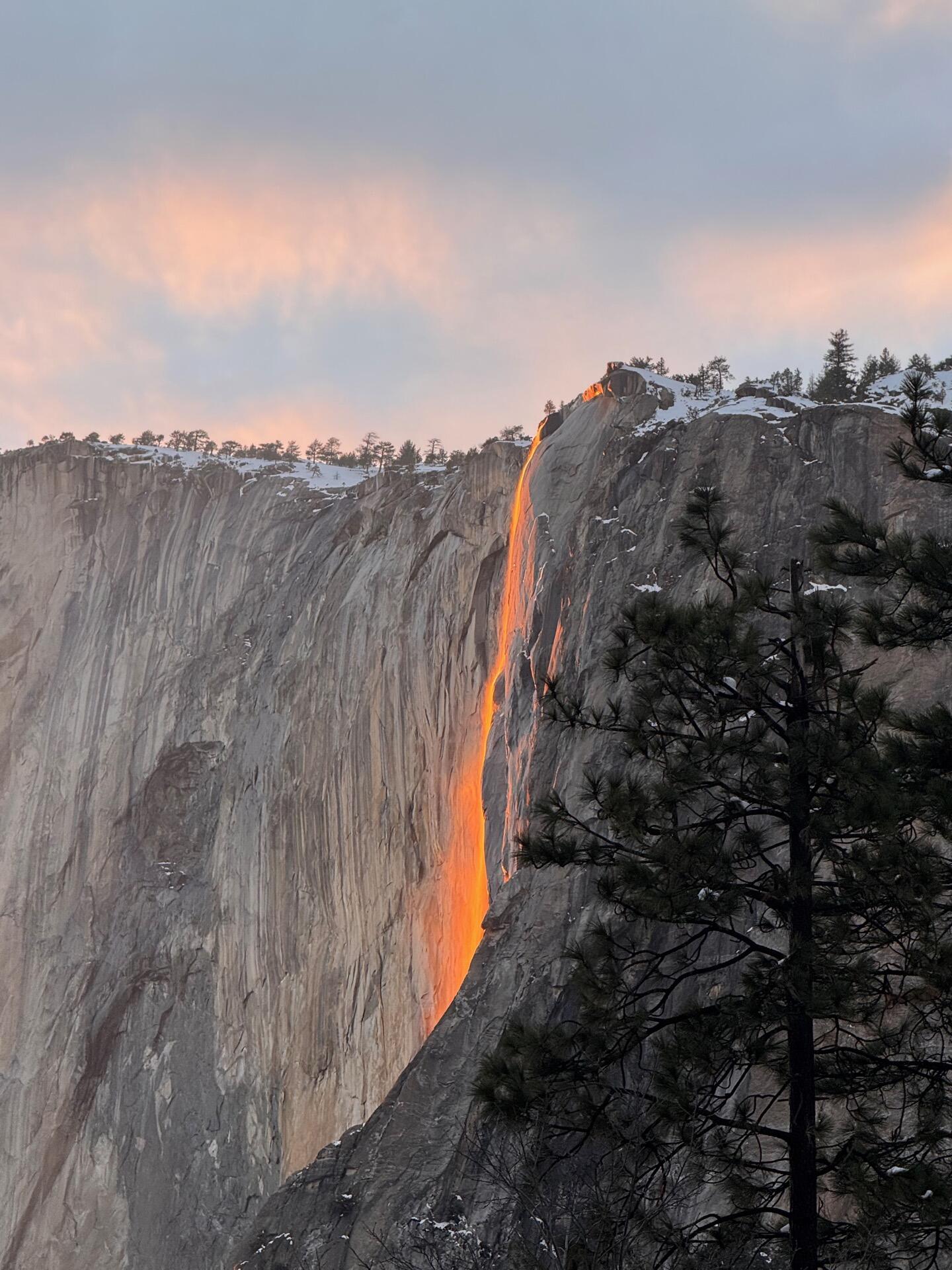
Every February, for roughly two weeks, Horsetail Fall on the east face of El Capitan is lit at sunset by the last light of the day — turning the waterfall a deep, molten orange that looks exactly like flowing lava cascading down the granite. Photographers call it the Firefall.
The window is narrow — typically the second and third weeks of February. It only works when the winter snowpack has kept Horsetail Fall running. It is also entirely weather dependent — a single bank of cloud at sunset and the effect simply does not happen. We know where to stand, when to arrive, and what to hope for.
Half Dome cables
The Half Dome cables — the fixed rope route to the summit — require a permit applied for well in advance via lottery. The cables are only in place from May to October. Outside that window the climb is extremely dangerous; the granite becomes lethally slippery with even the slightest moisture, and people have died attempting it without cables.
Even within the season, people have died on the cables. This is a serious, strenuous undertaking that demands respect and proper preparation. For the cables specifically, we strongly recommend approach shoes — a hybrid between hiking boots and rock climbing shoes with sticky rubber soles. The final section is sheer, smooth granite at a steep angle; standard hiking boots offer far less grip.
Accommodation in and around Yosemite
The Ahwahnee Hotel inside the park is one of the great historic hotels of the American West — stone and timber, built in 1927, with views of Half Dome from the dining room. It books out up to a year ahead for peak season dates. Book as soon as your dates are confirmed.
Camp 4 is the legendary climbers' campground — walk-up sites only, first come first served, requiring flexibility and an early arrival. Worth it for the atmosphere if camping is your thing.
Mariposa, just outside the park boundary, is a lovely small town with good restaurants and serves well as a base. More accommodation options, lower prices, and none of the in-park booking pressure.
Bears and wildlife
Black bears are present throughout Yosemite. They are not typically aggressive, but they are powerful, fast and very interested in food. Store all food in the bear boxes provided at campsites and car parks. Never leave food in your car — bears have learned to recognise cool boxes and bags and will break windows to reach them.
Sequoia National Park
The General Sherman Tree is the largest living thing on earth by volume — 52,500 cubic feet of wood, roughly 2,700 years old. Standing next to it recalibrates your sense of scale in a way that is genuinely difficult to describe and impossible to forget.
The Congress Trail is a loop through the Giant Forest that passes multiple enormous sequoias and is one of the finest walks in California. Allow two to three hours and go early to beat the crowds.
Sequoia is two hours south of Yosemite and less visited, which makes it feel wilder and more remote. If you are combining both parks, allow at least two nights in each. Do not try to do both in a single day.
Practical information for national park visits
A National Parks Pass (America the Beautiful) costs $80 and covers entry to all US national parks for a year. If you are visiting more than two parks it pays for itself immediately.
Yosemite requires timed entry reservations in summer — these open 28 days in advance and go quickly. Book at recreation.gov as soon as the window opens.
Footwear matters enormously. Never buy new hiking shoes for a trip like this — break them in thoroughly at home over weeks before you travel. New shoes on a wilderness trail mean blisters, and blisters on a multi-hour hike in the backcountry can ruin an extraordinary day.
Carry far more water than you think you need. Dehydration happens quickly at altitude and in the heat, and many trails are further from water sources than they appear on the map.
The kind of thing we know
The Firefall — and why most visitors miss it
This photo was taken by Dan in February 2026. We know where to stand, when to arrive, and what conditions to hope for. The window is roughly two weeks in mid-February. The effect requires snowpack, a clear sky and exact timing. Most visitors to Yosemite have never heard of it.
This is the kind of knowledge we bring to every itinerary. If the Firefall is on your list, we will make sure you are in the right place at the right time.
Plan a trip around moments like this